
Quick Takeaway
- Session budgeting matters more than any single shot decision on a Juwa 777 fish table.
- Setting a coin budget before you start prevents in-the-moment decisions from draining your balance.
- Tracking spend-to-kill ratio mid-session tells you more than your total balance alone.
- Boss fish attempts deserve their own budget carve-out, separate from regular play.
- Recognizing stopping signals matters more than trying to will yourself to stop later.
Weapon choice and boss fish timing both affect how efficiently you spend coins on a Juwa 777 fish table.
But neither matters much if there’s no budget structure around the session as a whole.
This piece is specifically about that structure — setting a budget, tracking it as you play, and recognizing when to stop. Not fish table mechanics broadly, just the coin management layer that sits above them.
For the mechanics this budgeting connects to, see Juwa 777 Boss Fish Mechanics.
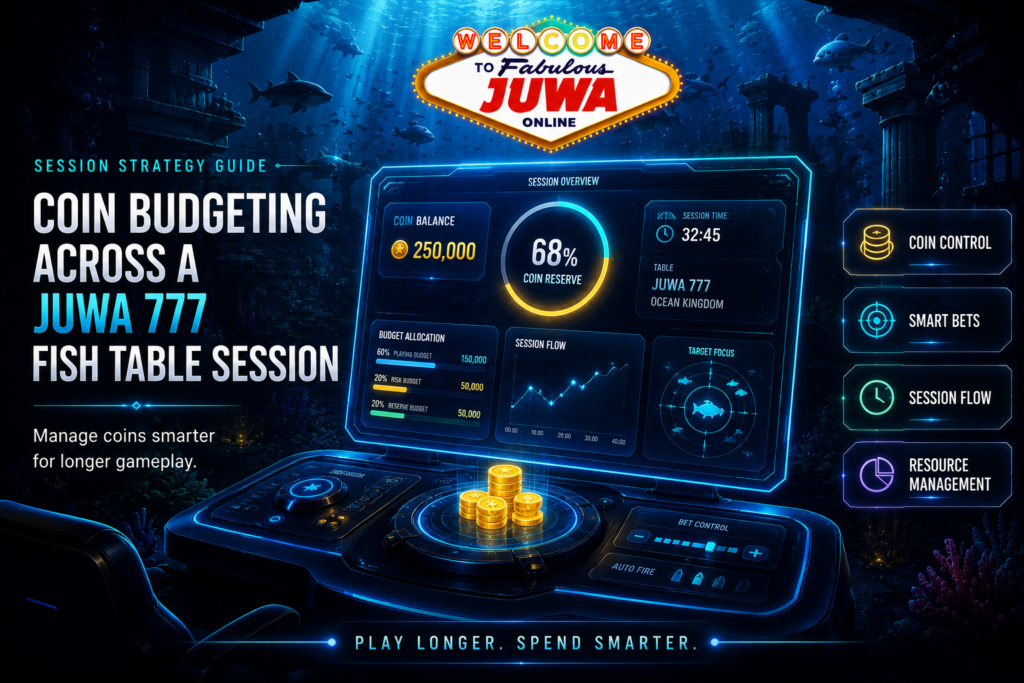
Why Session Budgeting Matters More Than Any Single Shot
Any individual shot on a fish table is a small decision. A session is made up of hundreds of them.
The cumulative effect of small decisions is what actually determines how a session goes, not any one weapon choice or boss fish attempt in isolation.
A player who makes efficient weapon choices but has no overall budget structure can still burn through a balance fast. A player with a clear budget, even with average shot-by-shot decisions, tends to have more control over how a session unfolds.
Budgeting isn’t a replacement for understanding mechanics. It’s the layer that determines how much room those mechanics have to work in.
Setting a Budget Before You Start
A coin budget set before opening the app functions differently than a budget decided mid-session.
Deciding your limit in advance removes the decision from a moment when your balance, and your judgment about it, may already be affected by how the session is going.
A practical budget isn’t just a total number. It helps to think in terms of:
- A total coin amount you’re comfortable spending in the session.
- A rough split between regular play and any boss fish attempts.
- A point at which you’ll stop regardless of how the session has gone.
Writing this down, even informally, before starting tends to hold up better than a budget that only exists as an intention.
Tracking Spend-to-Kill Ratio Mid-Session
Your total coin balance tells you where you stand. It doesn’t tell you how efficiently you got there.
Spend-to-kill ratio — how many coins you’re spending per successful kill — is a more useful mid-session signal than balance alone.
A balance that’s dropping steadily but producing regular kills reflects a session that’s working as expected. A balance dropping quickly with few kills to show for it is a sign that something in your approach, whether weapon choice or target selection, needs to change.
Checking this ratio periodically, rather than only glancing at total balance, catches inefficient stretches earlier.
Budgeting Around Boss Fish Attempts Specifically
Boss fish attempts carry a different risk profile than regular play, and the budget for them should reflect that.
As covered in our Juwa 777 Boss Fish Mechanics breakdown, a boss fish attempt can end with no payout at all if the spawn escapes before its health depletes. That makes boss fish spending fundamentally different from spending on smaller, more reliable targets.
Setting aside a specific portion of your session budget for boss fish attempts — separate from your regular play budget — keeps one expensive, uncertain attempt from consuming coins meant for the rest of the session.
If that boss fish portion is spent and the attempt didn’t land, stepping back rather than pulling from the regular play budget keeps the rest of the session intact.
Recognizing When to Stop
Knowing when to stop matters more than most players give it credit for, and it works better as a set of signals than as a willpower decision made in the moment.
Signals worth setting in advance:
- Reaching the total budget set before the session started.
- A spend-to-kill ratio that’s stayed poor across multiple targets in a row.
- A boss fish budget that’s been spent without a kill.
- Simply reaching the time you’d planned to play, regardless of balance.
Deciding these signals ahead of time removes the need to make that judgment call while still in the middle of a session.
Common Budgeting Mistakes
A few patterns show up repeatedly in sessions that end with more spent than planned.
- Starting to play without any budget number in mind at all.
- Treating a losing stretch as a reason to increase spend rather than step back.
- Pulling from a regular play budget to fund an unplanned boss fish attempt.
- Ignoring spend-to-kill ratio and only checking total balance at the end.
Any one of these turns a planned session into an unplanned one.
For the complete breakdown of every game category and coin structure on Juwa 777, visit Juwa 777 Games and Bonuses Guide.
FAQ
How much should I budget for a Juwa 777 fish table session?
There’s no universal number. A workable budget is one set in advance, based on what you’re comfortable spending, and treated as a firm limit rather than a suggestion.
Should boss fish attempts come out of my regular budget?
Setting aside a separate portion specifically for boss fish attempts is generally more effective than pulling from your regular play budget, since boss fish carry a real chance of no payout at all.
What’s a spend-to-kill ratio and why does it matter?
It’s the number of coins spent per successful kill. Tracking it mid-session shows efficiency in a way your total balance alone doesn’t.
What should I do if I go over my budget?
Stopping the session is the most direct response. A budget only works as a limit if it’s treated as one when it’s reached, not adjusted upward in the moment.
Ready to put this budgeting framework into your next session?
Visit our Juwa 777 Login Guide to get into your account quickly across Android, iOS, and desktop.”
juwa777.chat is an independent guide and awareness site published for informational purposes only.
We are not affiliated with Juwa 777, its operators, agents, or any platform referenced on this site in any form.
Nothing here constitutes financial, legal, or gambling advice — always verify information independently, do your own due diligence before trusting any agent or third party, and confirm all details directly with official sources before making any decisions.
Legal status of social casino platforms varies by US state — always check your specific state’s current regulations. Play responsibly — visit our Responsible Gaming page for US support resources.