
Quick Takeaway
- Boss fish carry far larger health pools than regular targets, which changes how you should approach them.
- In shared-board formats, the player who lands the final shot often takes the full payout, not everyone who damaged it.
- Reading a boss fish’s health bar before committing coins prevents wasted attempts.
- Boss fish can escape or time out, and an incomplete attempt still costs real coins.
- Deciding whether to engage a boss fish at all is as important as how you engage it.
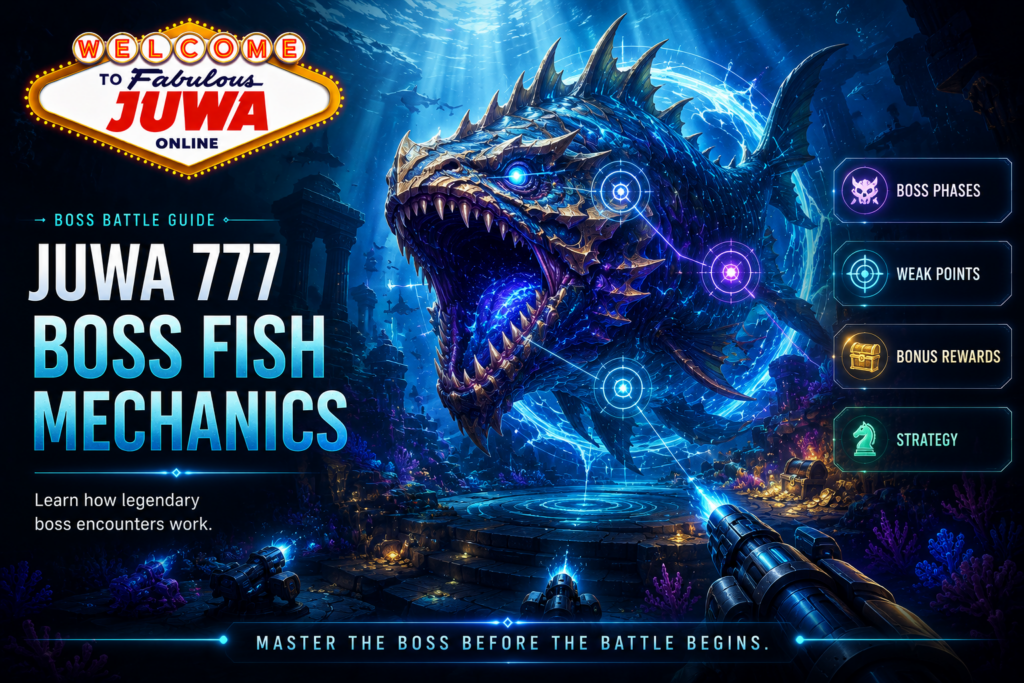
Boss fish are the moment every fish table session builds toward.
They’re bigger, they move differently, and the payout is worth chasing.
But most fish table content stops at “boss fish pay more” and leaves it there. That’s not enough to actually play them well.
This piece goes deeper into the specific mechanics — how kill credit works, how to read a boss fish’s health, when they escape, and how to judge whether an attempt is even worth starting.
For the broader picture of fish table games on the platform, see How Juwa Fish Games Work.
What Makes a Boss Fish Different From Regular Targets
Boss fish aren’t just larger versions of regular fish. They run on a different set of mechanics entirely.
Health pools are the biggest difference.
A regular fish might go down in one or two hits from a mid-tier cannon. A boss fish absorbs dozens of hits before its health depletes, regardless of weapon tier.
Movement patterns differ too. Boss fish tend to move slower and more predictably than smaller fish, which is partly what makes sustained fire against them possible in the first place.
Fast, erratic movement would make landing repeated hits on a high-health target far harder than it already is.
Most fish tables also signal a boss fish spawn with a visual or audio cue — a distinct entrance animation, a health bar overlay, or both. That cue is your first decision point: engage now, or wait.
How Kill Credit Works in Shared-Board Formats
This is the mechanic most players misunderstand, and it changes the entire calculation around whether to engage a boss fish.
On shared boards, multiple players can fire at the same boss fish simultaneously. Every shot that lands contributes to depleting its health bar.
But damage contribution and payout credit are not the same thing.
In many fish table formats, the payout for a boss fish kill goes to whichever player lands the final, killing shot — not to everyone who damaged it along the way.
That means a player who spent hundreds of coins weakening a boss fish can watch someone else land the kill shot and take the full payout.
It also means a player who waits and fires only when a boss fish is already weakened by other players’ fire can land a kill far more cheaply than the player who engaged first.
This dynamic is worth understanding before committing meaningful coins to any boss fish attempt. It directly shapes the timing decisions covered next.
Reading a Boss Fish’s Health Bar and Timing Your Attempt
A boss fish’s health bar is the single most useful piece of information on screen once it spawns.
A fresh spawn at full health represents the most expensive kill scenario. Every shot you fire is contributing to a health pool that hasn’t been touched.
A boss fish already weakened by other players’ fire represents a far more efficient opportunity. Fewer of your own shots are needed to land the kill, and — depending on the platform’s kill-credit rules — the payout may still go to whoever lands that final hit.
Watching the health bar rather than just the fish itself is how experienced players decide when to commit their heaviest weapon.
For the complete breakdown of cannon tiers and cost per shot, visit our Cannon Tiers and Cost Per Shot guide.
Firing early on a fresh spawn with a heavy cannon front-loads your coin spend before you know whether you’ll actually land the kill. Waiting and reading the bar reduces that risk.
Escape Behavior — What Happens When a Boss Fish Times Out
Boss fish don’t stay on screen indefinitely.
Most boss fish spawns run on a timer or a set movement path, and if their health isn’t depleted before that window closes, they leave the board without paying out anyone.
This is the outcome that makes boss fish genuinely risky rather than simply “high value.” Every coin spent on an attempt that doesn’t land a kill before the boss fish escapes is gone with nothing to show for it.
Recognizing the signs of a fish that’s likely to time out — health barely moving despite sustained fire from multiple players, or a boss fish reaching the edge of its movement path — is part of deciding whether to keep committing coins or pull back.
Deciding Whether an Attempt Is Worth Starting
Not every boss fish spawn is worth engaging, and that decision matters more than any single shot.
A few factors worth weighing before committing:
- Your current coin balance, and whether it can absorb an unsuccessful attempt without ending your session early.
- Whether the boss fish is fresh or already weakened by other players.
- How much time is likely left before the spawn’s window closes.
- Whether the board otherwise has smaller, reliable targets you’d be giving up coin flow from to chase the boss fish instead.
Skipping a boss fish spawn is a legitimate strategic choice, not a missed opportunity by default.
A fresh, heavily defended boss fish with a shrinking time window is often a worse coin decision than a session spent on steady small and medium fish.
For the complete session coin budgeting framework that covers exactly how to structure your balance around boss fish attempts, visit our Coin Budgeting in Fish Table Games guide.
Common Boss Fish Mistakes
A handful of habits account for most of the coins lost chasing boss fish.
- Committing a heavy cannon to a fresh spawn before checking whether other players are already engaging it.
- Continuing to fire after a boss fish’s health bar shows almost no movement over several shots.
- Ignoring the countdown or movement cues that signal an imminent escape.
- Treating every boss fish spawn as worth chasing regardless of coin balance.
Any one of these can turn a single boss fish spawn into the most expensive stretch of an entire session.
FAQ
Do all players who damage a boss fish get paid when it’s killed?
Not necessarily. In many shared-board formats, the payout goes to whoever lands the final killing shot, not to every player who contributed damage.
Why did my boss fish attempt not pay out anything?
If the boss fish’s health wasn’t fully depleted before its spawn window closed, it can escape without paying anyone, regardless of how many shots were fired at it.
Is it better to engage a boss fish early or wait?
Waiting until a boss fish is already weakened by other players’ fire is generally more coin-efficient, since fewer of your own shots are needed to land the kill.
Should beginners try to kill boss fish?
Boss fish attempts carry more risk than steady small-fish play. New players often benefit from building familiarity with weapon switching and coin pacing before committing to boss fish attempts.
Ready to apply these boss fish mechanics in your next session?
Visit our Juwa 777 Login Guide to access your account quickly across Android, iOS, and desktop.
juwa777.chat is an independent guide and awareness site published for informational purposes only.
We are not affiliated with Juwa 777, its operators, agents, or any platform referenced on this site in any form.
Nothing here constitutes financial, legal, or gambling advice — always verify information independently, do your own due diligence before trusting any agent or third party, and confirm all details directly with official sources before making any decisions.
Legal status of social casino platforms varies by US state — always check your specific state’s current regulations. Play responsibly — visit our Responsible Gaming page for US support resources.